
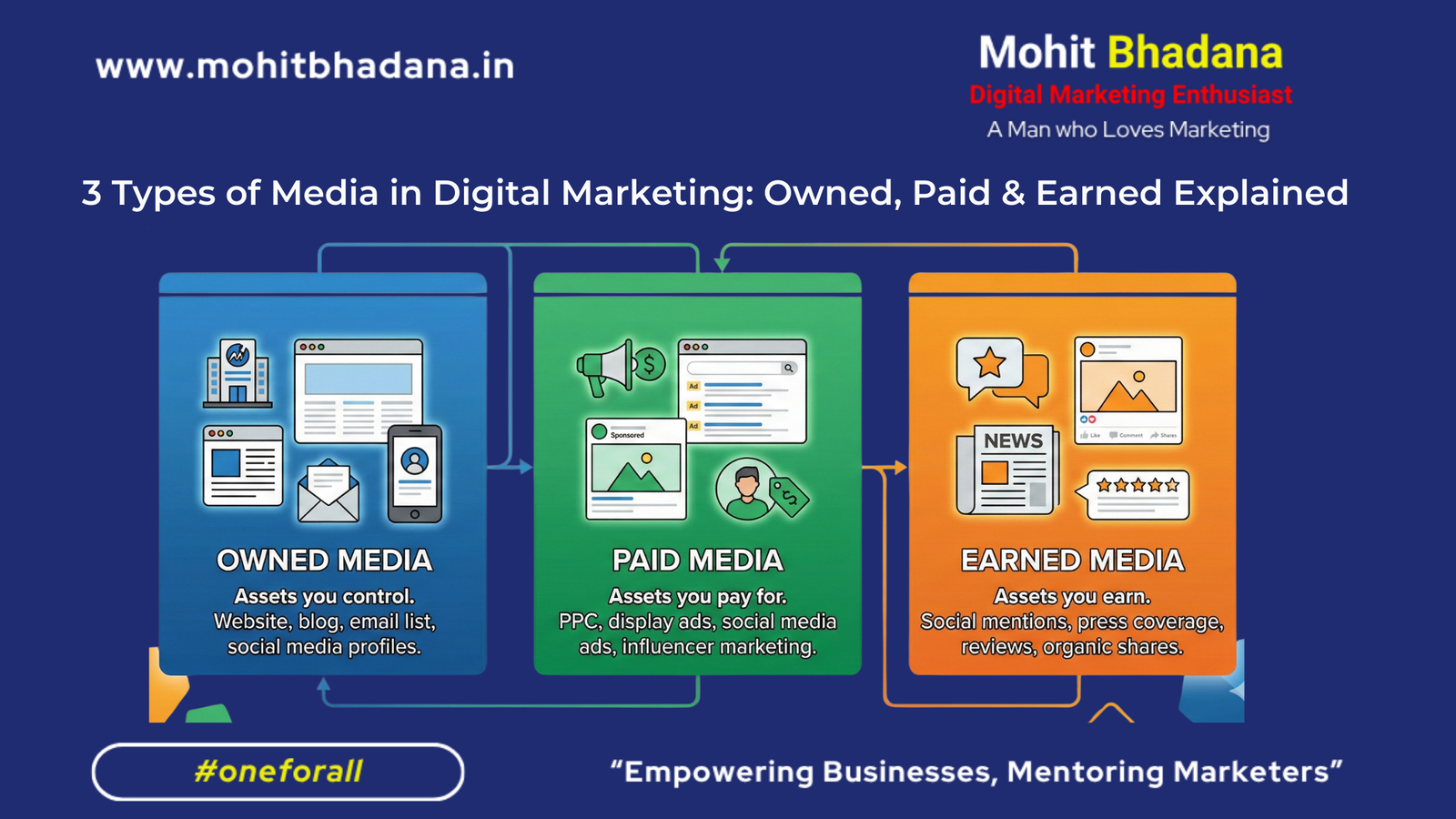
Blog Summary In digital marketing, every successful brand uses a mix of Owned, Paid, and Earned Media to build visibility, trust, and conversions. This blog breaks down what each type means, its unique advantages, and how you can integrate them into your marketing strategy for maximum impact. 3 Types of Media in Digital Marketing: Owned, Paid & Earned In today’s digital landscape, businesses have countless ways to reach their audience. But every marketing effort — from social media posts to ads and PR mentions — fits into one of three categories of media: – Owned Media – Paid Media – Earned Media Understanding how these work (and how to balance them) is key to building a strong, sustainable digital presence. 1. Owned Media — Your Digital Assets Definition: Owned media refers to all the online properties your brand owns and controls — where you can share content freely and maintain your brand identity. Examples: Your website, blog, email newsletters, mobile app, and social media handles. 💡 Real-World Example: Zomato Zomato’s owned media is a masterclass in brand communication.Their official app and website not only allow users to order food but also showcase restaurant ratings, delivery insights, and user reviews — all carefully structured for SEO and engagement.Zomato also uses its Instagram and LinkedIn pages as extensions of its voice — mixing humor, trends, and food culture that reflect its unique personality. Takeaway: Zomato owns its communication platforms and uses them consistently to build a relatable, high-engagement community. 2. Paid Media — Your Amplifier Definition: Paid media includes every form of paid promotion you use to attract new audiences and drive quick conversions. Examples: Google Ads, Meta Ads, influencer sponsorships, YouTube ads, and display advertising. 💡 Real-World Example: Zepto Zepto’s launch campaign, “10-Minute Delivery,” became the talk of the town thanks to strategic paid advertising.They invested heavily in: Takeaway: Zepto used Paid Media to create mass awareness fast, then leveraged Owned and Earned Media to sustain it. 3. Earned Media — The Power of Reputation Definition: Earned media is unpaid exposure gained when others talk about your brand — reviews, shares, news mentions, or viral content. Examples: Press coverage, organic influencer mentions, social shares, and UGC (user-generated content). 💡 Real-World Example: boAt boAt earned massive visibility through organic influencer advocacy and social media buzz.Fans proudly call themselves “boAtheads” and share their experience online — not because they’re paid to, but because they love the product.This earned exposure also extends to celebrity shoutouts and press features, which boosted the brand’s trust factor without massive ad spends. Takeaway: boAt’s earned media success comes from authentic brand love and community building — turning customers into promoters. How They Combine All Three (Integration Example) Let’s connect the dots 👇 Similarly, boAt relies on community-driven Earned Media while reinforcing its brand with Owned content and Paid influencer partnerships. How Owned, Paid, and Earned Media Work Together The magic happens when all three media types work in sync. Media Type Control Cost Objective Owned Full Low Build trust & educate audience Paid Partial Medium/High Drive traffic & conversions Earned None Free (indirect) Build credibility & awareness Example of Integration: You publish a blog on your website (owned). You run Facebook Ads to promote it (paid). People share it and mention your brand online (earned).→ That’s the perfect digital marketing loop. Best Practices for Balancing the 3 Media Types When done right, the trio creates a sustainable growth system — one that scales reach, engagement, and brand authority together. FAQs 1. What are the 3 types of media in digital marketing? The three main types are Owned Media, Paid Media, and Earned Media. Owned is what you control, Paid is what you promote, and Earned is what others say about you. 2. Why is it important to balance owned, paid, and earned media? Balancing all three helps build trust (earned), increase reach (paid), and maintain authority (owned). Relying on only one type limits your brand’s growth. 3. What is an example of earned media? An influencer mentioning your product or a happy customer sharing your post without being paid — that’s earned media. 4. Which media type gives the fastest results? Paid media gives instant visibility and traffic, while owned and earned media build long-term value. 5. How do I measure the effectiveness of each media type? Use analytics: learn more about Online consumer behaviour in today’s Digital era – read now Mohit BhadanaDigital Marketing Strategist , Consultant & Trainer mohitbhadana.in

What are DA and PA, and How Do You Check These SEO Metrics?
What are DA and PA? A Complete Guide to Domain & Page Authority Ever feel like your website’s content is great, but it’s still not ranking well on Google? The issue might be your website’s Domain Authority (DA) and Page Authority (PA). These SEO metrics help you understand how strong your website and individual pages are in the eyes of search engines. In this guide, we will break down what DA and PA are, how they work, and how you can check them to improve your SEO performance. What is Domain Authority (DA)? Understanding Domain Authority Domain Authority (DA) is a score that predicts how well a website will rank on search engine results pages (SERPs). Developed by Moz, the DA score ranges from 0 to 100. A higher DA score indicates a better chance of ranking well in search results. Factors Influencing Domain Authority Real-World Example: Imagine you run a popular blog about Indian recipes. If other high-authority food blogs and websites link to your content, your DA will improve, making your website more likely to rank for keywords like “best biryani recipes.” What is Page Authority (PA)? Understanding Page Authority Page Authority (PA) measures the ranking strength of a specific page, rather than the entire website. Also developed by Moz, it uses a similar scale from 0 to 100. Higher PA scores mean better chances of ranking high for specific keywords. Factors Influencing Page Authority Real-World Example: Suppose you have an article titled “What is Marketing? Understanding the 7Ps and 4Cs of Marketing.” If it receives backlinks from other marketing websites, its PA will increase, making it more likely to rank high for related search terms. How to Check DA and PA? Using Moz Tools Moz provides powerful tools to check both DA and PA: Using Third-Party Tools Other tools provide similar metrics: These tools may have different names for DA and PA but offer similar insights. Simply enter your website URL, and you’ll receive scores along with backlinks and keyword performance data. DA vs. PA: What’s the Difference? Factor Domain Authority (DA) Page Authority (PA) Scope Entire domain Individual pages Main Focus Overall website strength Specific page strength Influenced By Backlinks, domain age, site structure On-page SEO, content quality, backlinks Best For Measuring overall site health Targeting specific keywords or topics Which Metric Should You Focus On? How to Improve Your DA and PA Improving Domain Authority Improving Page Authority Conclusion Understanding Domain Authority (DA) and Page Authority (PA) is essential for improving your website’s SEO performance. Monitoring these metrics helps you identify strengths and weaknesses, guiding you to create a better-optimized website. Start by checking your DA and PA with tools like Moz or Ahrefs and work on enhancing them using the tips provided. FAQs 1. What is Domain Authority (DA)? DA is a metric that predicts how well a website will rank on search engines, measured on a scale of 0 to 100 by Moz. 2. What is Page Authority (PA)? PA measures the ranking strength of an individual page on a website, using a similar 0 to 100 scale. 3. How can I check my website’s DA and PA? Use tools like Moz Link Explorer, MozBar, Ahrefs, and Semrush to check your website’s DA and PA. 4. How can I improve my DA and PA? Focus on building high-quality backlinks, optimizing on-page SEO, enhancing user experience, and producing valuable content. 5. What’s the difference between DA and PA? DA measures overall domain strength, while PA measures the strength of individual pages. Mohit BhadanaDigital Marketing Strategist , Consultant & Trainer mohitbhadana.in
What is a Targeted Audience and How to Create a Buyer Persona?
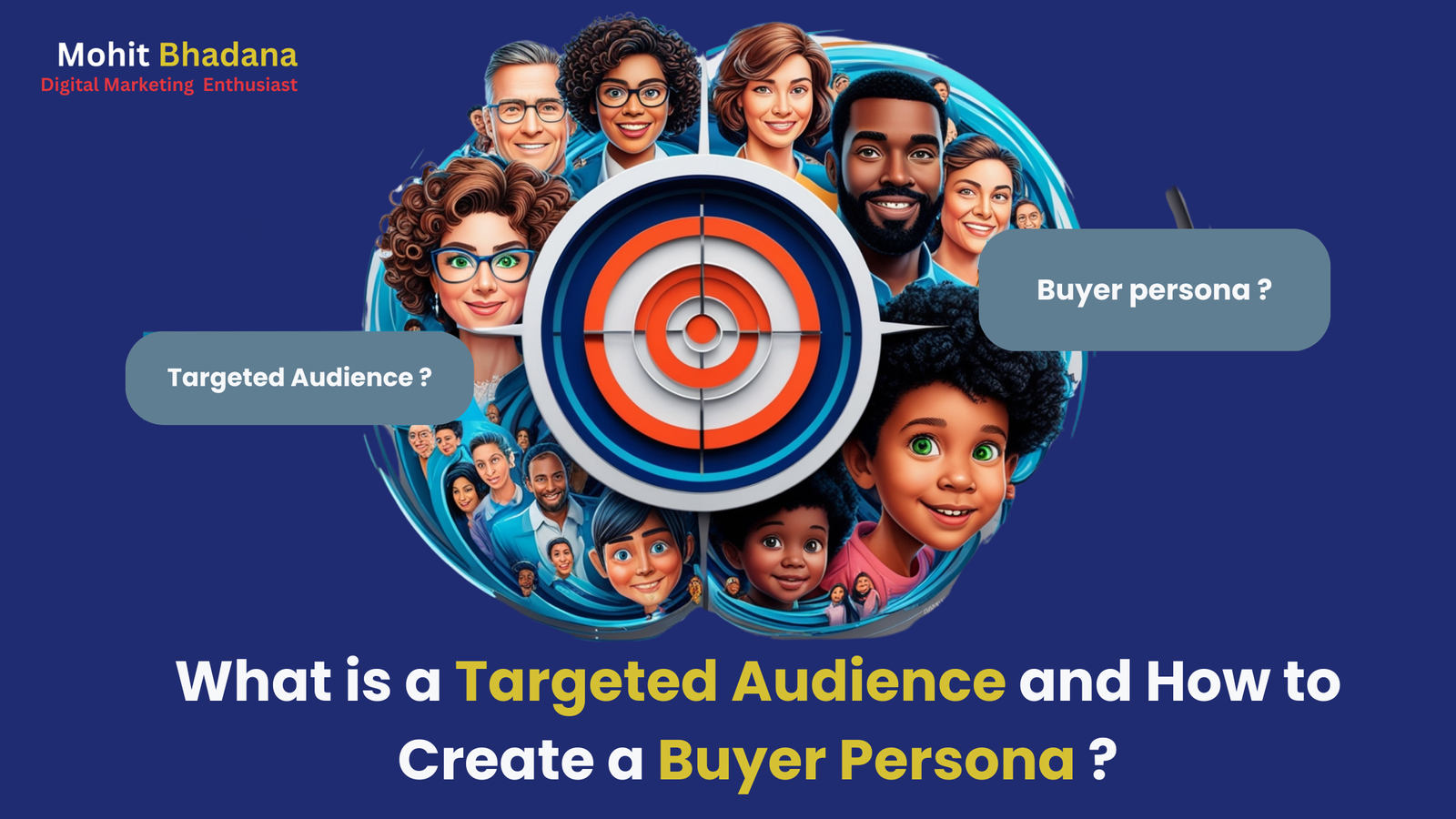
Blog Summary Ever felt like your marketing efforts are not reaching the right people? You’re not alone. Many businesses struggle with ineffective campaigns simply because they aren’t targeting the right audience. The key to successful marketing is identifying your targeted audience and crafting buyer personas to tailor your approach. In this article, we will explore what a targeted audience is, why it matters, and how to create buyer personas that will help you refine your marketing strategies for better engagement and higher conversions. What is a Targeted Audience? A targeted audience is a specific group of people who are most likely to be interested in your products or services. Instead of marketing to everyone, you focus on those who are most relevant to your brand. Key Characteristics of a Targeted Audience ✔ Demographics – Age, gender, income, education, occupation.✔ Psychographics – Interests, values, lifestyle, personality.✔ Behavioral Traits – Shopping habits, brand loyalty, frequency of purchase.✔ Geographics – Location, climate, urban/rural settings. Why Defining Your Target Audience is Crucial 🎯 Increases marketing efficiency – Your ads reach people who actually care about your product.🎯 Saves time and budget – No more wasting money on irrelevant audiences.🎯 Boosts engagement and conversions – Customers relate better to personalized messaging. Real-World Example: Target Audience Segmentation in India Let’s take Nykaa, a leading Indian beauty brand. Their target audience includes: ✔ Young urban women (18-35 years) interested in beauty and skincare.✔ Men looking for grooming products.✔ Brides-to-be searching for wedding skincare solutions.✔ Professionals seeking premium skincare. Nykaa effectively segments its audience and tailors marketing campaigns accordingly, leading to higher engagement and brand loyalty. What is a Buyer Persona? A buyer persona is a semi-fictional profile or an Imaginary form of your Targeted audience that represents your ideal customer. It helps businesses understand customer needs, behaviours, and pain points. Benefits of Creating Buyer Personas ✔ More personalized marketing campaigns.✔ Better product development based on customer pain points.✔ Improved customer service and experience.✔ Higher conversion rates and engagement. How to Conduct Research for Your Buyer Personas 1️⃣ Customer Interviews – Talk to real customers and understand their challenges.2️⃣ Website Analytics – Use tools like Google Analytics to track demographics and behaviours.3️⃣ Social Media Insights – Check Facebook, Instagram, and LinkedIn analytics for audience data.4️⃣ Surveys and Feedback Forms – Collect responses through Google Forms, Typeform, or SurveyMonkey. Step-by-Step Guide to Creating a Buyer Persona 1. Identify Key Characteristics and Pain Points 2. Give Your Persona a Name and Backstory 3. Define Goals, Challenges, and Motivations Example of a Buyer Persona (Indian Audience) Persona Example 1: Aarav, the Digital Marketer ✔ Age: 27✔ Occupation: Digital Marketing Manager✔ Income: ₹8 LPA✔ Location: Mumbai✔ Goals: Stay updated with digital trends, improve marketing ROI✔ Challenges: High competition, limited ad budgets✔ Motivations: Innovation, measurable results, career growth Persona Example 2: Priya, the Budget-Conscious Shopper ✔ Age: 32✔ Occupation: Homemaker✔ Income: ₹5 LPA (Household Income)✔ Location: Delhi✔ Goals: Buy high-quality yet affordable beauty products✔ Challenges: Finding authentic brands on a budget✔ Motivations: Discounts, cashback offers, word-of-mouth reviews Conclusion Identifying your target audience and creating buyer personas is crucial for effective marketing. By understanding who your customers are, what they need, and how they behave, you can craft personalized campaigns that drive better engagement and conversions. 👉 Start defining your target audience today and create detailed buyer personas to unlock your brand’s full potential! 🚀 Learn more about Marketing through Marketing Blogs FAQs 1. What is a targeted audience in marketing? A targeted audience is a specific group of people most likely to be interested in your products or services based on demographics, psychographics, and behavior. 2. Why is it important to define a target audience? It helps businesses focus their marketing efforts, reduce ad spend, and improve engagement by reaching the right people. 3. How do I identify my target audience? Use customer research, website analytics, social media insights, and surveys to analyze user demographics, interests, and behaviors. 4. What is a buyer persona? A buyer persona is a semi-fictional profile representing an ideal customer, including age, job, goals, pain points, and motivations. 5. How can buyer personas improve my marketing strategy? Buyer personas help businesses create personalized marketing messages, refine product offerings, and enhance customer experiences. 6. Can a business have multiple buyer personas? Yes! Businesses often have multiple personas based on different customer segments, product lines, or target markets. Mohit BhadanaDigital Marketing Strategist , Consultant & Trainer mohitbhadana.in
What Are Search Engines and How Do They Work?
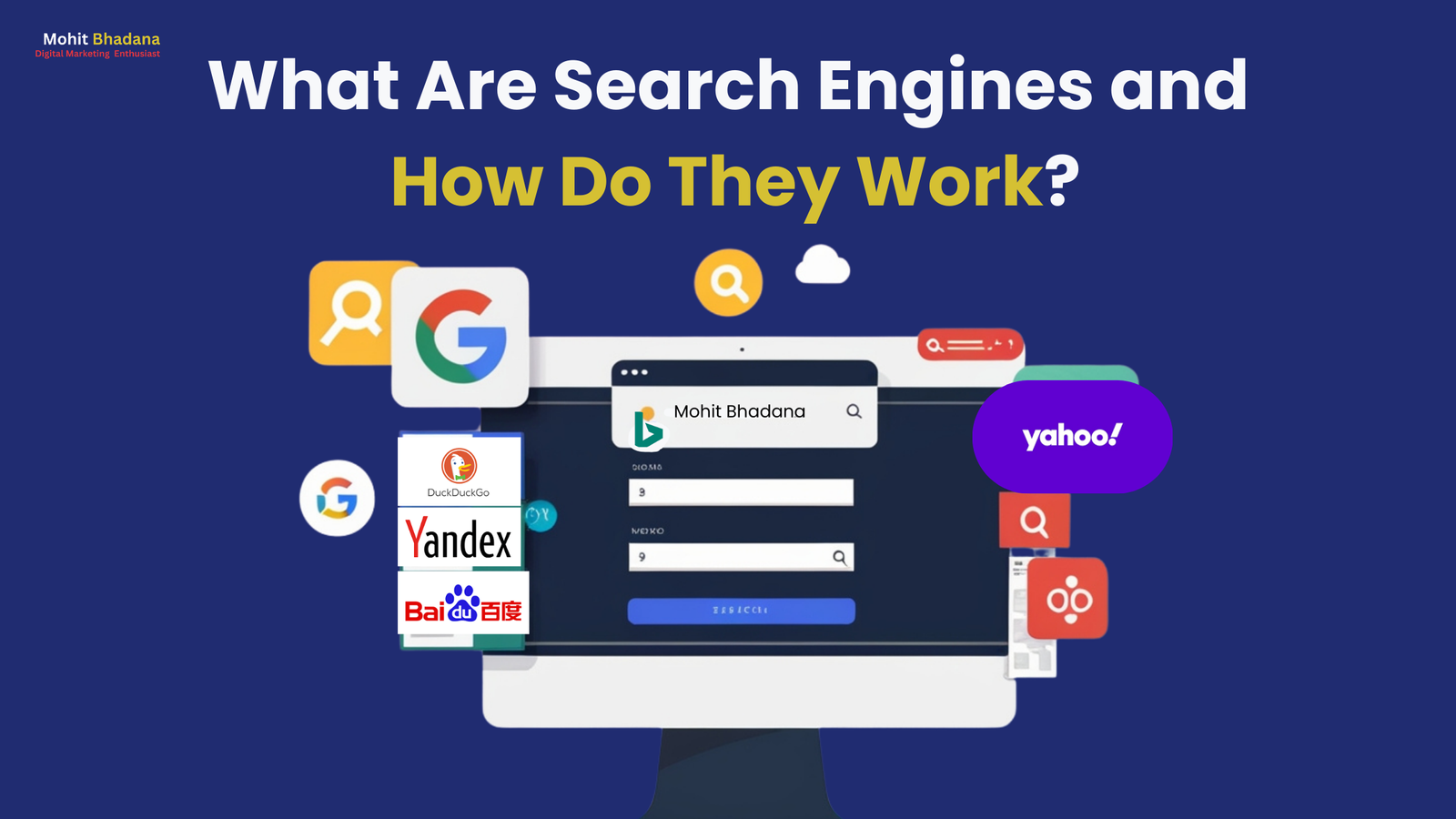
Blog Summary: This blog explains how search engines function, covering the four-step process: Crawling, Indexing, Retrieval, and Ranking. Learn key ranking factors, types of search engine results, and how to optimize your website for better visibility Introduction Search engines have become an integral part of our daily lives, helping us find information, products, and services within seconds. Whether you’re searching for the latest news, a local restaurant, or a tutorial, search engines like Google, Bing, and Yahoo provide the most relevant results. But have you ever wondered how search engines work? In this article, we will break down the key components of search engines, how they function, and the factors that influence search rankings. What Is a Search Engine? A search engine is an online tool or website that helps users find information by displaying relevant web pages based on their search queries. The most popular search engines include: Each search engine uses complex algorithms to analyze and rank billions of web pages in milliseconds, providing users with the most relevant results. How Do Search Engines Work? Search engines follow a four-step process to index and rank web pages: 1. Crawling Search engines use automated bots called crawlers or spiders to scan the internet and discover new or updated content. These bots move from one page to another through links, gathering data about websites. Key Aspects of Crawling: 2. Indexing Once a search engine crawls a website, it stores and organizes the collected data in a massive database called an index. This index helps the search engine retrieve relevant results when a user performs a search. Key Aspects of Indexing: 3. Retrieval When a user submits a search query, the search engine fetches the most relevant data from its index. This process ensures that users receive the best possible results for their searches. Key Aspects of Retrieval: 4. Ranking After retrieving relevant pages, the search engine ranks them based on relevance and authority. The ranking is determined by a complex algorithm that considers hundreds of ranking factors. Key Ranking Factors: ✅ Keywords – How well the page matches the search query.✅ Backlinks – Links from other trusted websites improve authority.✅ User Experience (UX) – Fast loading speed, mobile-friendliness, and easy navigation.✅ Content Quality – Original, valuable, and engaging content ranks higher.✅ Domain Authority – Websites with high credibility and trust rank better.✅ Page Structure – Optimized headings, meta descriptions, and schema markup help improve ranking. Types of Search Engine Results Search engines display results in multiple formats: 1. Organic Search Results These are non-paid listings ranked based on relevance and SEO (Search Engine Optimization). Websites that follow SEO best practices rank higher in organic search results. 2. Paid Search Results (PPC Ads) Businesses pay for Google Ads or Bing Ads to display at the top of search results for specific keywords. These are marked as “Sponsored” or “Ad.” 3. Featured Snippets A featured snippet is a highlighted search result that appears at the top of Google. It provides a direct answer to a query, often in bullet points, tables, or paragraphs. 4. Local Search Results (Google My Business) Google displays local businesses in a map pack based on proximity, relevance, and reviews. For example, searching “restaurants near me” shows nearby listings with reviews and directions. 5. Video and Image Search Google and Bing rank videos and images separately in their video and image search sections. Platforms like YouTube also rank video content using their own algorithms. Conclusion Search engines have revolutionized how we access information, making it easier to find relevant content within seconds. They work through a four-step process: Crawling, Indexing, Retrieval, and Ranking, using complex algorithms to provide the best results. For website owners and businesses, understanding SEO and optimizing content can improve search rankings, increase traffic, and grow online visibility. By following SEO best practices, anyone can enhance their online presence and reach their target audience effectively. To learn more about SEO strategy check SEO Notes by Mohit Bhadana FAQs 1. What is the main function of a search engine? A search engine helps users find relevant information online by crawling, indexing, retrieving, and ranking web pages based on search queries. 2. How does Google decide which websites rank higher? Google ranks websites based on relevance, content quality, backlinks, user experience, and hundreds of algorithmic factors to ensure the best results. 3. What is the difference between organic and paid search results? Organic results appear naturally based on SEO, while paid search results (PPC ads) are sponsored listings that businesses pay for. 4. How often do search engines update their algorithms? Major search engines like Google frequently update their algorithms, with core updates happening multiple times a year to improve search accuracy and user experience. 5. How can I optimize my website for better ranking? You can optimize your website using SEO best practices, including keyword research, high-quality content, backlinks, mobile-friendliness, and fast loading speeds. 6. What is local SEO, and how does it work? Local SEO helps businesses rank in location-based searches by optimizing Google My Business profiles, customer reviews, and local keywords. Mohit BhadanaDigital Marketing Strategist , Consultant & Trainer mohitbhadana.in