Blog Summary
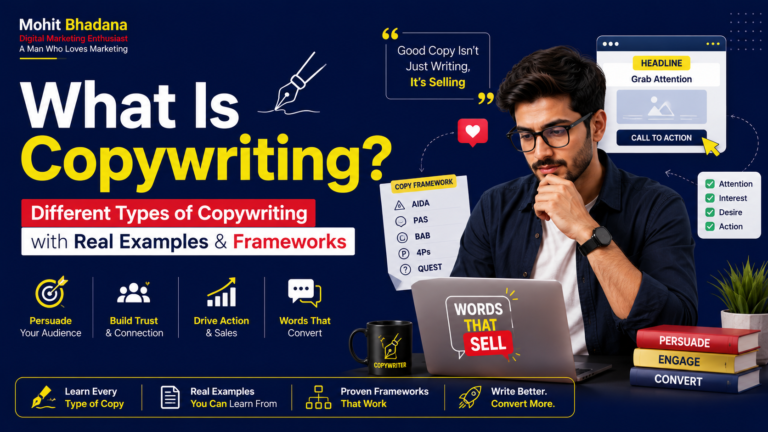
Copywriting is one of the most valuable skills in digital marketing because it helps businesses persuade customers to take action. Whether it’s clicking an ad, filling out a form, purchasing a product, or booking a consultation, effective copywriting influences every stage of the customer journey. In this guide, you’ll learn what copywriting is, the different types of copywriting, and how to apply five proven copywriting frameworks—PAS, AIDA, QUEST, 4Ps, and SLAP—using practical healthcare industry examples. This article is designed for marketers, business owners, freelancers, and students who want to write copy that converts
What Is Copywriting, and What Are the Different Types of Copywriting with Examples?
Introduction
Every successful advertisement, landing page, email, social media post, or sales page begins with one essential element—great copywriting.
Think about the last time you clicked a Google Ad, signed up for a webinar, or purchased a product online. Chances are, the words you read influenced your decision. Those carefully crafted words are known as copy.
Copywriting is more than writing attractive headlines. It’s the art and science of understanding customer psychology and using persuasive language to encourage people to take a specific action.
Whether you’re running Google Ads, creating landing pages, writing emails, or managing social media campaigns, learning what copywriting is and how to use copywriting can significantly improve your marketing performance.
In this guide, we’ll explore the fundamentals of copywriting, the different types of copywriting, and five proven copywriting frameworks used by professional marketers worldwide.
What Is Copywriting?
Copywriting is the process of writing persuasive marketing content that encourages readers to take a specific action.
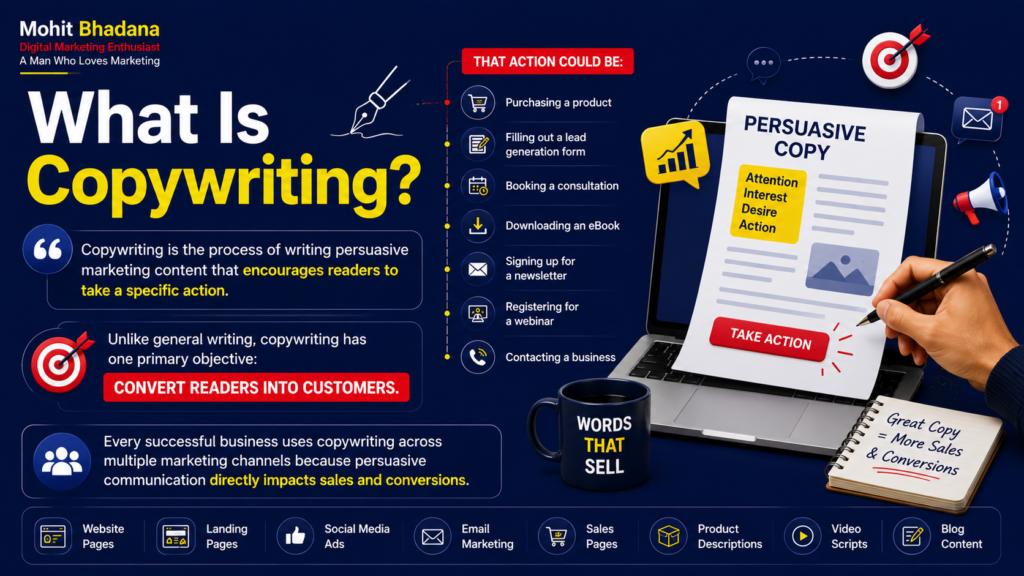
That action could be:
- Purchasing a product
- Filling out a lead generation form
- Booking a consultation
- Downloading an eBook
- Signing up for a newsletter
- Registering for a webinar
- Contacting a business
Unlike general writing, copywriting has one primary objective:
Convert readers into customers.
Every successful business uses copywriting across multiple marketing channels because persuasive communication directly impacts sales and conversions.
Why Is Copywriting Important?
Modern consumers see thousands of advertisements every day. Great copywriting helps businesses stand out from the competition by communicating value clearly and persuasively.
Effective copywriting helps businesses:
- Generate qualified leads
- Increase website conversions
- Improve click-through rates (CTR)
- Build customer trust
- Increase product sales
- Strengthen brand awareness
- Improve return on advertising spend (ROAS)
Whether you’re a startup or an established enterprise, strong copy can significantly influence customer decisions.
Copywriting vs Content Writing
Many beginners confuse copywriting with content writing, but they serve different purposes.
| Copywriting | Content Writing |
| Persuades readers to take action | Educates or informs readers |
| Sales-focused | Information-focused |
| Short and conversion-oriented | Detailed and educational |
| Used in ads, emails, landing pages | Used in blogs, guides, and tutorials |
| Primary goal: Conversion | Primary goal: Education |
For example:
A blog explaining “What is SEO?” is content writing.
A landing page convincing visitors to purchase an SEO course is copywriting.
The best digital marketing strategies combine both.
Different Types of Copywriting
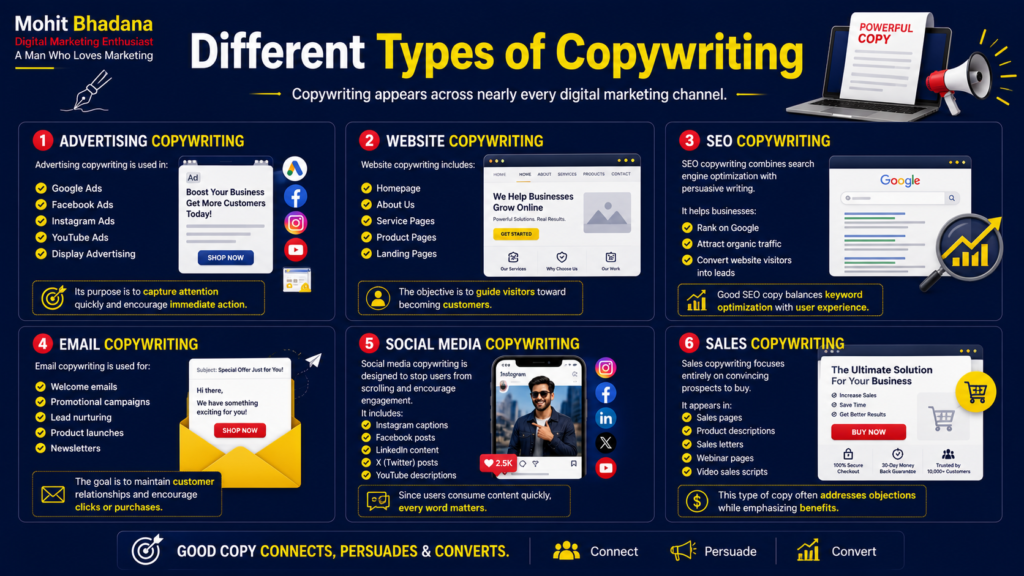
Copywriting appears across nearly every digital marketing channel.
1. Advertising Copywriting
Advertising copywriting is used in:
- Google Ads
- Facebook Ads
- Instagram Ads
- YouTube Ads
- Display Advertising
Its purpose is to capture attention quickly and encourage immediate action.
2. Website Copywriting
Website copywriting includes:
- Homepage
- About Us
- Service Pages
- Product Pages
- Landing Pages
The objective is to guide visitors toward becoming customers.
3. SEO Copywriting
SEO copywriting combines search engine optimization with persuasive writing.
It helps businesses:
- Rank on Google
- Attract organic traffic
- Convert website visitors into leads
Good SEO copy balances keyword optimization with user experience.
4. Email Copywriting
Email copywriting is used for:
- Welcome emails
- Promotional campaigns
- Lead nurturing
- Product launches
- Newsletters
The goal is to maintain customer relationships and encourage clicks or purchases.
5. Social Media Copywriting
Social media copywriting is designed to stop users from scrolling and encourage engagement.
It includes:
- Instagram captions
- Facebook posts
- LinkedIn content
- X (Twitter) posts
- YouTube descriptions
Since users consume content quickly, every word matters.
6. Sales Copywriting
Sales copywriting focuses entirely on convincing prospects to buy.
It appears in:
- Sales pages
- Product descriptions
- Sales letters
- Webinar pages
- Video sales scripts
This type of copy often addresses objections while emphasizing benefits.
What Is the Best Example of Copywriting?
One of the best examples of copywriting is a Google Search Ad.
Suppose someone searches:
“Home Nursing Services Near Me”
A well-written advertisement might read:
Hospital-Quality Care at Home
Certified nurses and compassionate caregivers available for elderly care, post-surgical recovery, and medical assistance.
Book Your Free Home Assessment Today.
In just a few lines, this advertisement:
- Captures attention
- Addresses a need
- Highlights benefits
- Includes a strong call-to-action
This is effective copywriting in action.
How to Use Copywriting Effectively
Professional copywriters rarely write without a structure.
Instead, they use proven frameworks that are based on consumer psychology.
The five most popular copywriting frameworks are:
- PAS
- AIDA
- QUEST
- 4Ps
- SLAP
Each framework works best for a specific marketing channel.
In the next section, we’ll explore each framework using a real healthcare and elderly home care business example, demonstrating exactly how professional marketers write copy for advertisements, landing pages, emails, sales pages, and social media.
The 5 Most Powerful Copywriting Frameworks (With Real Healthcare Examples)
Writing persuasive copy becomes much easier when you follow a proven framework instead of starting with a blank page. Professional copywriters don’t rely on creativity alone—they use structured formulas based on customer psychology.
Each framework is designed for a specific marketing channel. Choosing the right one can improve click-through rates, conversions, and customer engagement.
Let’s explore the five most widely used copywriting frameworks with real-world examples from the Home Care & Elderly Support industry.
1. PAS Framework (Problem – Agitation – Solution)
Best For:
- Google Ads
- Meta (Facebook & Instagram) Ads
- Display Ads
- Short Sales Copy
What is the PAS Framework?
The PAS (Problem–Agitation–Solution) framework is one of the most effective copywriting formulas for direct-response advertising. Instead of immediately promoting a product or service, it first addresses the customer’s biggest pain point.
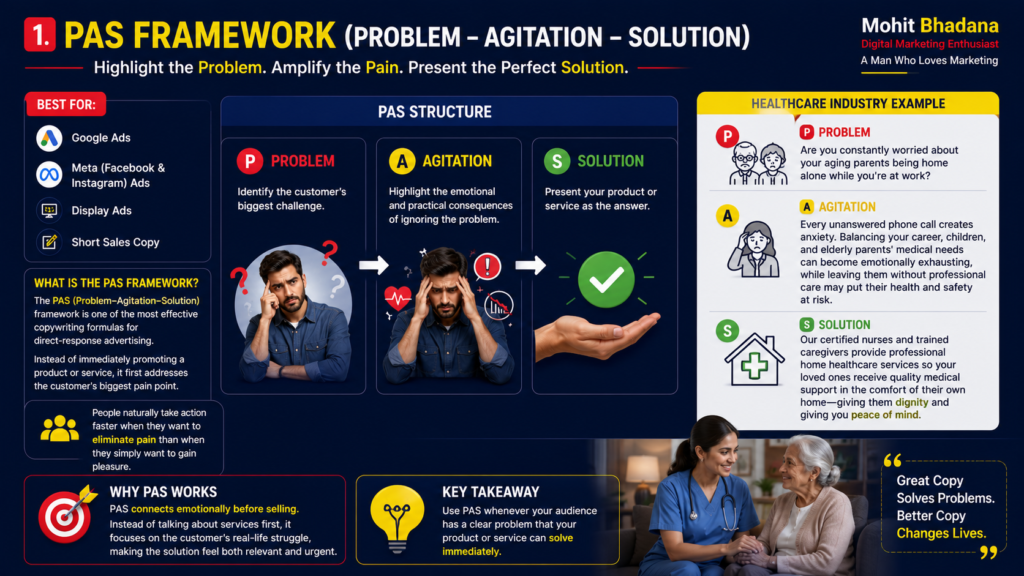
People naturally take action faster when they want to eliminate pain than when they simply want to gain pleasure.
PAS Structure
Problem
Identify the customer’s biggest challenge.
Agitation
Highlight the emotional and practical consequences of ignoring the problem.
Solution
Present your product or service as the answer.
Healthcare Industry Example
Problem
Are you constantly worried about your ageing parents being home alone while you’re at work?
Agitation
Every unanswered phone call creates anxiety. Balancing your career, children, and elderly parents’ medical needs can become emotionally exhausting, while leaving them without professional care may put their health and safety at risk.
Solution
Our certified nurses and trained caregivers provide professional home healthcare services so your loved ones receive quality medical support in the comfort of their own home—giving them dignity and giving you peace of mind.
Why PAS Works
PAS connects emotionally before selling. Instead of talking about services first, it focuses on the customer’s real-life struggle, making the solution feel both relevant and urgent.
Key Takeaway
Use PAS whenever your audience has a clear problem that your product or service can solve immediately.
2. AIDA Framework (Attention – Interest – Desire – Action)
Best For
- Landing Pages
- Website Homepages
- Service Pages
- Sales Pages
What is the AIDA Framework?
AIDA is one of the oldest and most trusted copywriting frameworks. It guides potential customers through a logical buying journey—from grabbing their attention to encouraging them to take action.
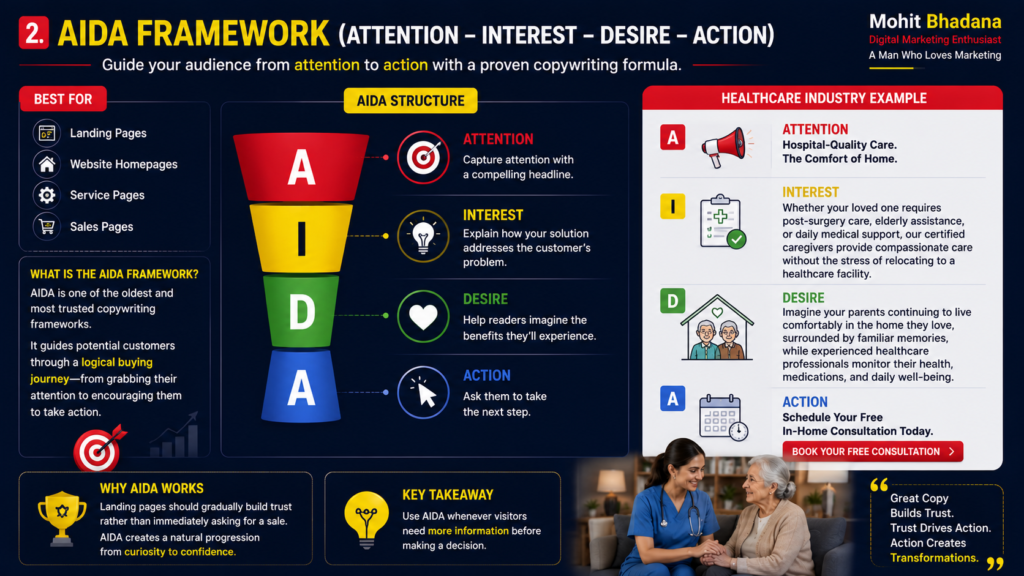
AIDA Structure
Attention
Capture attention with a compelling headline.
Interest
Explain how your solution addresses the customer’s problem.
Desire
Help readers imagine the benefits they’ll experience.
Action
Ask them to take the next step.
Healthcare Industry Example
Attention
Hospital-Quality Care. The Comfort of Home.
Interest
Whether your loved one requires post-surgery care, elderly assistance, or daily medical support, our certified caregivers provide compassionate care without the stress of relocating to a healthcare facility.
Desire
Imagine your parents continuing to live comfortably in the home they love, surrounded by familiar memories, while experienced healthcare professionals monitor their health, medications, and daily well-being.
Action
Schedule Your Free In-Home Consultation Today.
Why AIDA Works
Landing pages should gradually build trust rather than immediately asking for a sale. AIDA creates a natural progression from curiosity to confidence.
Key Takeaway
Use AIDA whenever visitors need more information before making a decision.
3. QUEST Framework (Qualify – Understand – Educate – Stimulate – Transition)
Best For
- Sales Letters
- Long-form Sales Pages
- Webinar Scripts
- Brochures
- Consultation Pages
What is the QUEST Framework?
The QUEST framework focuses on empathy and relationship building.
Instead of immediately selling, it first proves that you truly understand your audience before introducing your solution.
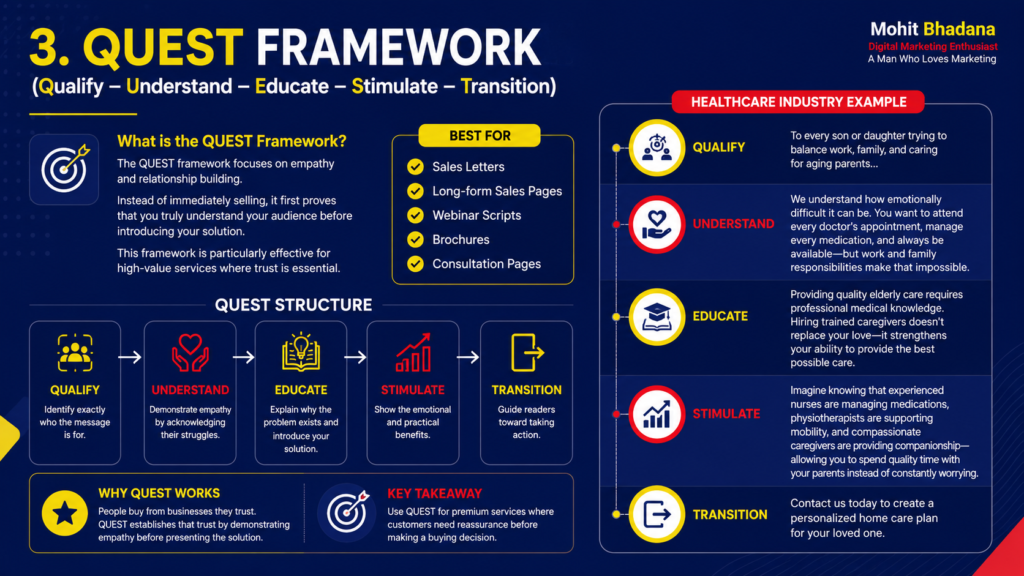
This framework is particularly effective for high-value services where trust is essential.
QUEST Structure
Qualify
Identify exactly who the message is for.
Understand
Demonstrate empathy by acknowledging their struggles.
Educate
Explain why the problem exists and introduce your solution.
Stimulate
Show the emotional and practical benefits.
Transition
Guide readers toward taking action.
Healthcare Industry Example
Qualify
To every son or daughter trying to balance work, family, and caring for aging parents…
Understand
We understand how emotionally difficult it can be. You want to attend every doctor’s appointment, manage every medication, and always be available—but work and family responsibilities make that impossible.
Educate
Providing quality elderly care requires professional medical knowledge. Hiring trained caregivers doesn’t replace your love—it strengthens your ability to provide the best possible care.
Stimulate
Imagine knowing that experienced nurses are managing medications, physiotherapists are supporting mobility, and compassionate caregivers are providing companionship—allowing you to spend quality time with your parents instead of constantly worrying.
Transition
Contact us today to create a personalized home care plan for your loved one.
Why QUEST Works
People buy from businesses they trust.
QUEST establishes that trust by demonstrating empathy before presenting the solution.
Key Takeaway
Use QUEST for premium services where customers need reassurance before making a buying decision.
4. 4Ps Framework (Picture – Promise – Prove – Push)
Best For
- Email Marketing
- Lead Nurturing Campaigns
- Follow-up Emails
- Customer Retention Emails
What is the 4Ps Framework?
The 4Ps framework uses storytelling to help readers visualize a better future.
Rather than immediately discussing products or services, it paints a picture of the desired outcome.
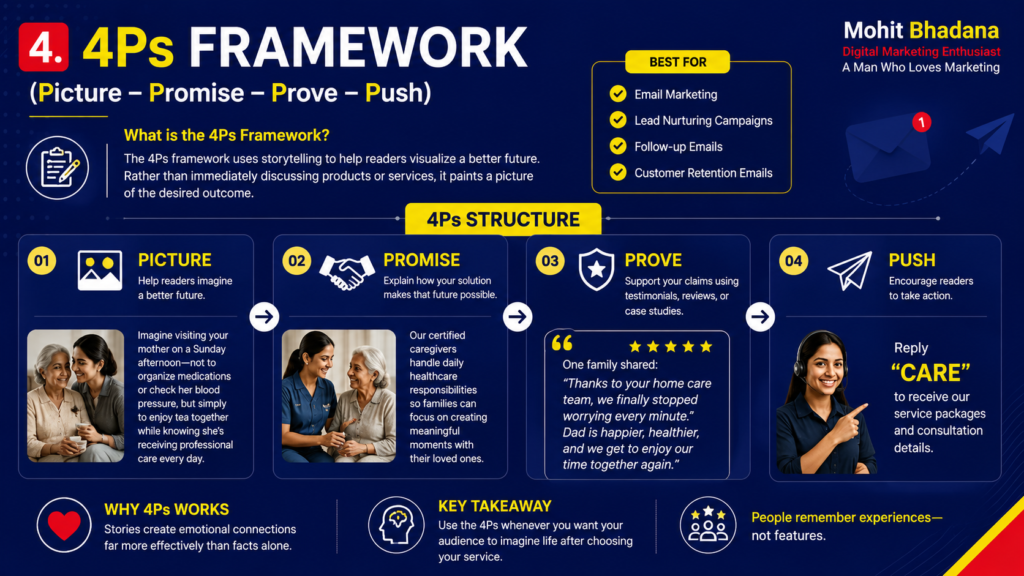
4Ps Structure
Picture
Help readers imagine a better future.
Promise
Explain how your solution makes that future possible.
Prove
Support your claims using testimonials, reviews, or case studies.
Push
Encourage readers to take action.
Healthcare Industry Example
Picture
Imagine visiting your mother on a Sunday afternoon—not to organize medications or check her blood pressure, but simply to enjoy tea together while knowing she’s receiving professional care every day.
Promise
Our certified caregivers handle daily healthcare responsibilities so families can focus on creating meaningful moments with their loved ones.
Prove
One family shared:
“Thanks to your home care team, we finally stopped worrying every minute. Dad is happier, healthier, and we get to enjoy our time together again.”
Push
Reply “CARE” to receive our service packages and consultation details.
Why 4Ps Works
Stories create emotional connections far more effectively than facts alone.
People remember experiences—not features.
Key Takeaway
Use the 4Ps whenever you want your audience to imagine life after choosing your service.
5. SLAP Framework (Stop – Look – Act – Purchase)
Best For
- Instagram Posts
- Facebook Posts
- LinkedIn Posts
- Reels
- Short-form Videos
What is the SLAP Framework?
Social media users scroll quickly.
If your content doesn’t capture attention within the first few seconds, they’ll move on.
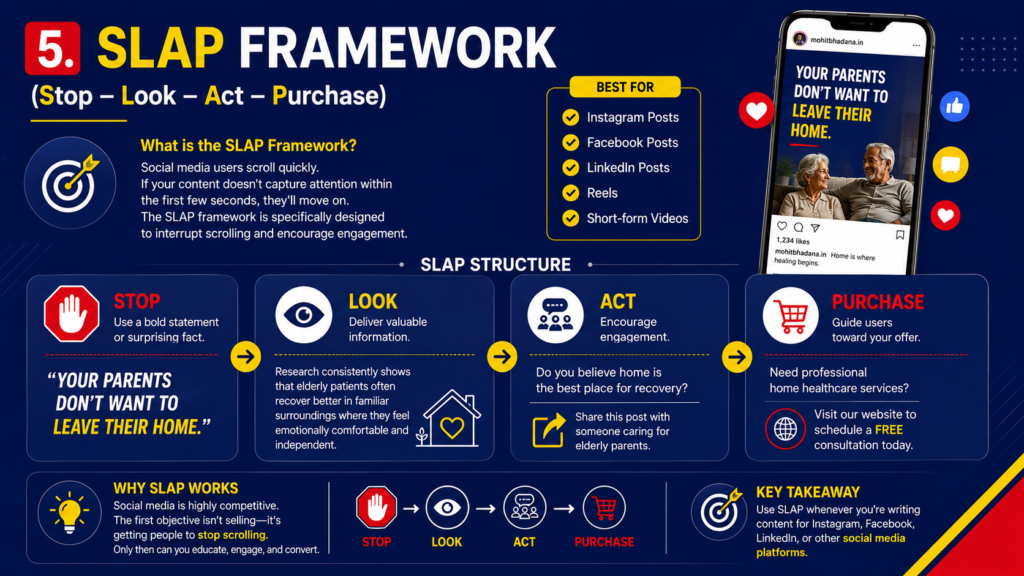
The SLAP framework is specifically designed to interrupt scrolling and encourage engagement.
SLAP Structure
Stop
Use a bold statement or surprising fact.
Look
Deliver valuable information.
Act
Encourage engagement.
Purchase
Guide users toward your offer.
Healthcare Industry Example
Stop
“Your Parents Don’t Want to Leave Their Home.”
Look
Research consistently shows that elderly patients often recover better in familiar surroundings where they feel emotionally comfortable and independent.
Act
Do you believe home is the best place for recovery?
Share this post with someone caring for elderly parents.
Purchase
Need professional home healthcare services?
Visit our website to schedule a free consultation today.
Why SLAP Works
Social media is highly competitive.
The first objective isn’t selling—it’s getting people to stop scrolling.
Only then can you educate, engage, and convert.
Key Takeaway
Use SLAP whenever you’re writing content for Instagram, Facebook, LinkedIn, or other social media platforms.
Which Copywriting Framework Should You Choose?
| Framework | Best Used For | Primary Goal |
| PAS | Google Ads, Meta Ads, Display Ads | Solve customer pain points quickly |
| AIDA | Landing Pages & Websites | Guide visitors toward conversion |
| QUEST | Sales Pages & Brochures | Build trust through empathy |
| 4Ps | Email Marketing | Tell stories and build relationships |
| SLAP | Social Media | Capture attention and increase engagement |
Pro Tip for Digital Marketers
The best marketers don’t rely on a single copywriting framework. Instead, they use different frameworks based on the marketing channel and the customer’s stage in the buying journey.
For example:
- Google Ads: PAS
- Landing Page: AIDA
- Sales Page: QUEST
- Email Campaign: 4Ps
- Instagram or LinkedIn: SLAP
When each stage of your marketing funnel uses the right copywriting formula, your messaging becomes more consistent, persuasive, and conversion-focused.
10 Copywriting Best Practices That Improve Conversions
Writing persuasive copy isn’t about using fancy vocabulary—it’s about understanding your audience and communicating value clearly. Here are ten best practices followed by professional copywriters.
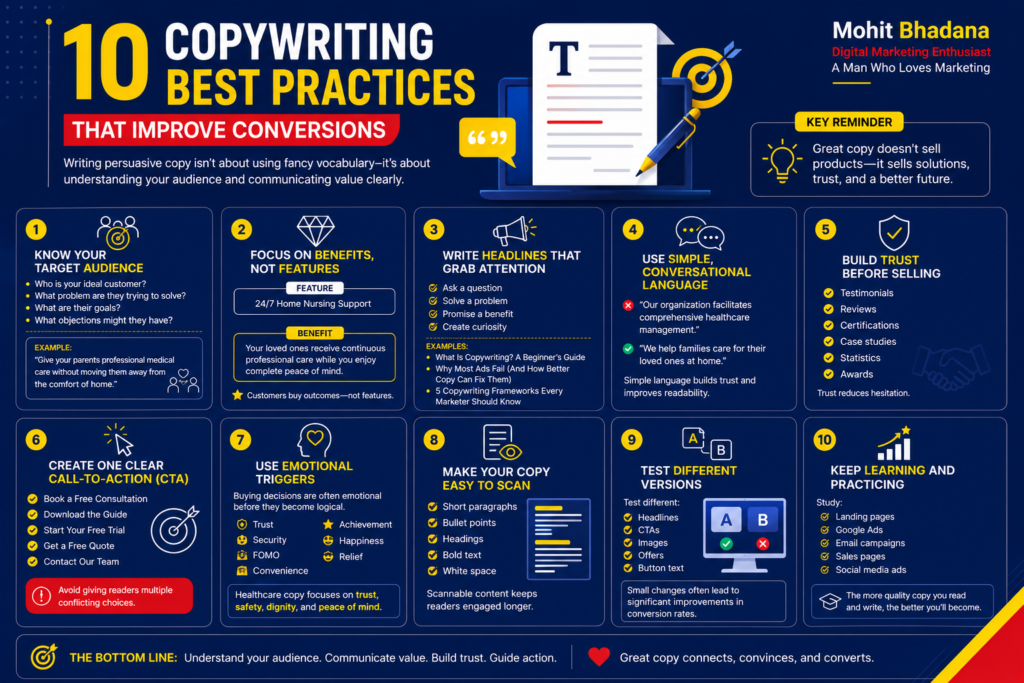
1. Know Your Target Audience
Before writing a single word, ask yourself:
- Who is your ideal customer?
- What problem are they trying to solve?
- What are their goals?
- What objections might they have?
The better you understand your audience, the more relevant your copy becomes.
Example:
A healthcare company shouldn’t advertise “Certified Medical Professionals.”
Instead, it should say:
“Give your parents professional medical care without moving them away from the comfort of home.”
The second version connects emotionally with the audience.
2. Focus on Benefits, Not Features
One of the biggest mistakes beginners make is listing features instead of explaining benefits.
Feature
24/7 Home Nursing Support
Benefit
Your loved ones receive continuous professional care while you enjoy complete peace of mind.
Remember:
Customers buy outcomes—not features.
3. Write Headlines That Grab Attention
Your headline determines whether people continue reading.
Good headlines:
- Ask a question
- Solve a problem
- Promise a benefit
- Create curiosity
Examples:
- What Is Copywriting? A Beginner’s Guide
- Why Most Ads Fail (And How Better Copy Can Fix Them)
- 5 Copywriting Frameworks Every Marketer Should Know
4. Use Simple, Conversational Language
Great copy sounds like a conversation.
Instead of writing:
“Our organization facilitates comprehensive healthcare management.”
Write:
“We help families care for their loved ones at home.”
Simple language builds trust and improves readability.
5. Build Trust Before Selling
People rarely buy from businesses they don’t trust.
Increase credibility by including:
- Testimonials
- Reviews
- Certifications
- Case studies
- Statistics
- Awards
Trust reduces hesitation.
6. Create One Clear Call-to-Action (CTA)
Every piece of copy should have one goal.
Examples:
- Book a Free Consultation
- Download the Guide
- Start Your Free Trial
- Get a Free Quote
- Contact Our Team
Avoid giving readers multiple conflicting choices.
7. Use Emotional Triggers
Buying decisions are often emotional before they become logical.
Common emotional triggers include:
- Trust
- Security
- Fear of missing out (FOMO)
- Convenience
- Achievement
- Happiness
- Relief
Healthcare copy often focuses on trust, safety, dignity, and peace of mind.
8. Make Your Copy Easy to Scan
Most users don’t read every word.
Improve readability by using:
- Short paragraphs
- Bullet points
- Headings
- Bold text
- White space
Scannable content keeps readers engaged longer.
9. Test Different Versions
Professional copywriters rarely publish the first version.
Test different:
- Headlines
- CTAs
- Images
- Offers
- Button text
Small changes often lead to significant improvements in conversion rates.
10. Keep Learning and Practicing
Copywriting is a skill that improves with practice.
Study:
- Landing pages
- Google Ads
- Email campaigns
- Sales pages
- Social media advertisements
The more quality copy you read and write, the better you’ll become.
Common Copywriting Mistakes to Avoid
Even experienced marketers make mistakes. Avoid these common pitfalls to create more effective copy.
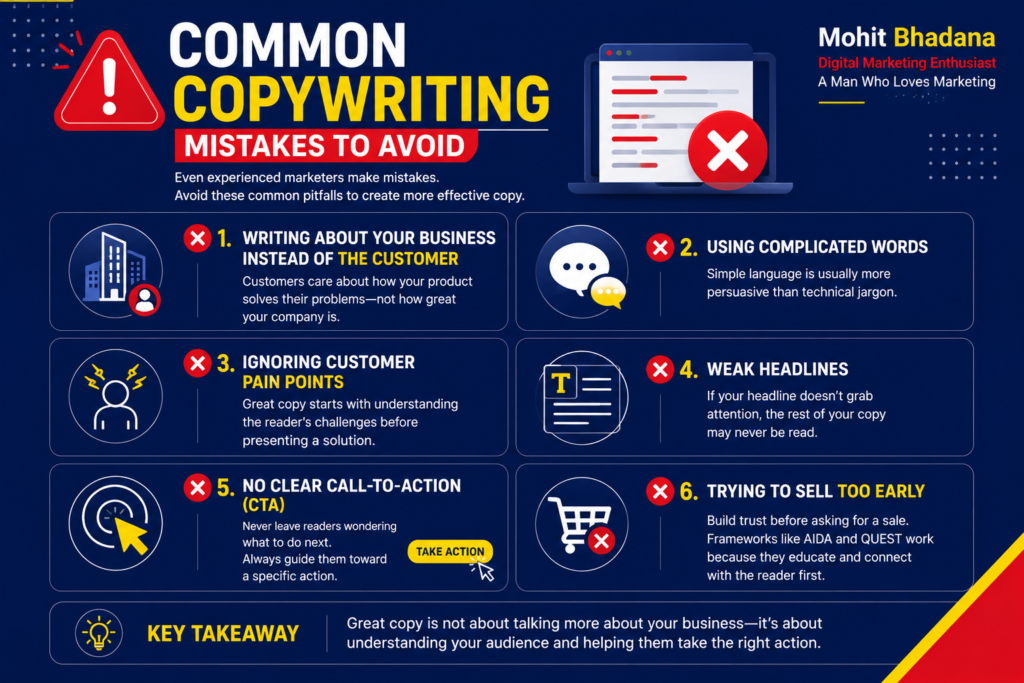
❌ Writing About Your Business Instead of the Customer
Customers care about how your product solves their problems—not how great your company is.
❌ Using Complicated Words
Simple language is usually more persuasive than technical jargon.
❌ Ignoring Customer Pain Points
Great copy starts with understanding the reader’s challenges before presenting a solution.
❌ Weak Headlines
If your headline doesn’t grab attention, the rest of your copy may never be read.
❌ No Clear Call-to-Action
Never leave readers wondering what to do next.
Always guide them toward a specific action.
❌ Trying to Sell Too Early
Build trust before asking for a sale.
Frameworks like AIDA and QUEST work because they educate and connect with the reader first.
How to Become Better at Copywriting
Like any professional skill, copywriting improves with consistent practice.
Here are a few habits that can accelerate your learning:
- Read successful advertisements every day.
- Analyze landing pages from leading brands.
- Rewrite headlines using different frameworks.
- Study customer reviews to understand real pain points.
- Practice writing copy for different industries.
- Learn from experienced copywriters and marketing campaigns.
- Test and measure your copy to see what performs best.
The more you write, edit, and test, the stronger your copywriting skills will become.
Conclusion
Copywriting is much more than writing catchy slogans or creative advertisements. It is a strategic marketing skill that combines psychology, communication, and persuasion to encourage people to take action.
In this guide, you’ve learned what copywriting is, explored the different types of copywriting, and discovered how professional marketers use proven frameworks such as PAS, AIDA, QUEST, 4Ps, and SLAP across advertisements, landing pages, sales pages, email campaigns, and social media.
Remember that there is no single framework that works for every situation. The key is choosing the right approach based on your marketing objective and where your audience is in the customer journey.
Whether you’re writing a Google Ad, creating a landing page, sending an email campaign, or publishing a social media post, structured copywriting helps you communicate more clearly, build trust, and improve conversions.
The best copywriters aren’t those who use the most complex words—they’re the ones who understand their audience and deliver the right message at the right time.
Frequently Asked Questions (FAQs)
1. What is copywriting?
Copywriting is the process of writing persuasive marketing content that encourages readers to take a specific action, such as making a purchase, signing up for a service, downloading a resource, or contacting a business.
2. What is the best example of copywriting?
A Google Search Ad, Facebook Ad, landing page, sales page, or email campaign are all excellent examples of copywriting because they are designed to persuade users to take action.
3. How do I use copywriting in digital marketing?
Copywriting is used across digital marketing channels, including Google Ads, Meta Ads, websites, landing pages, blogs, email campaigns, social media posts, product pages, and sales funnels to improve engagement and conversions.
4. What is the difference between copywriting and content writing?
Copywriting focuses on persuading readers to take action, while content writing focuses on educating, informing, or entertaining an audience. Both play important roles in a successful digital marketing strategy.
5. Which copywriting framework is best for Google Ads?
The PAS (Problem–Agitation–Solution) framework is widely used for Google Ads because it quickly addresses customer pain points and presents a compelling solution within a limited amount of space.
6. Which framework is best for landing pages?
The AIDA (Attention–Interest–Desire–Action) framework is ideal for landing pages because it guides visitors step by step through the buying journey.
7. What are the five most popular copywriting frameworks?
The five widely used copywriting frameworks are:
- PAS (Problem–Agitation–Solution)
- AIDA (Attention–Interest–Desire–Action)
- QUEST (Qualify–Understand–Educate–Stimulate–Transition)
- 4Ps (Picture–Promise–Prove–Push)
- SLAP (Stop–Look–Act–Purchase)
Each framework is designed for different marketing channels and objectives.
8. Can beginners learn copywriting?
Yes. Copywriting is a learnable skill. By understanding customer psychology, practicing regularly, and applying proven frameworks, beginners can develop effective copywriting skills over time.
Learn more about Digital Marketing – explore Digital marketing notes

Digital Marketing Strategist , Consultant & Trainer