


Blog Summary
A lead is a person who shows interest in your business by sharing their contact information, while lead generation is the process of attracting and converting potential customers into leads. Understanding the different types of leads, cold, warm, and hot, helps you tailor your marketing strategy effectively. By using proven methods like lead magnets, landing pages, paid ads, webinars, and SEO, businesses can consistently generate high-quality online leads. The key to success lies in offering value, capturing data, nurturing relationships, and converting leads into customers.
What is a Lead?
A lead is any person who shows interest in your product or service by sharing their contact details, such as their name, email address, or phone number.

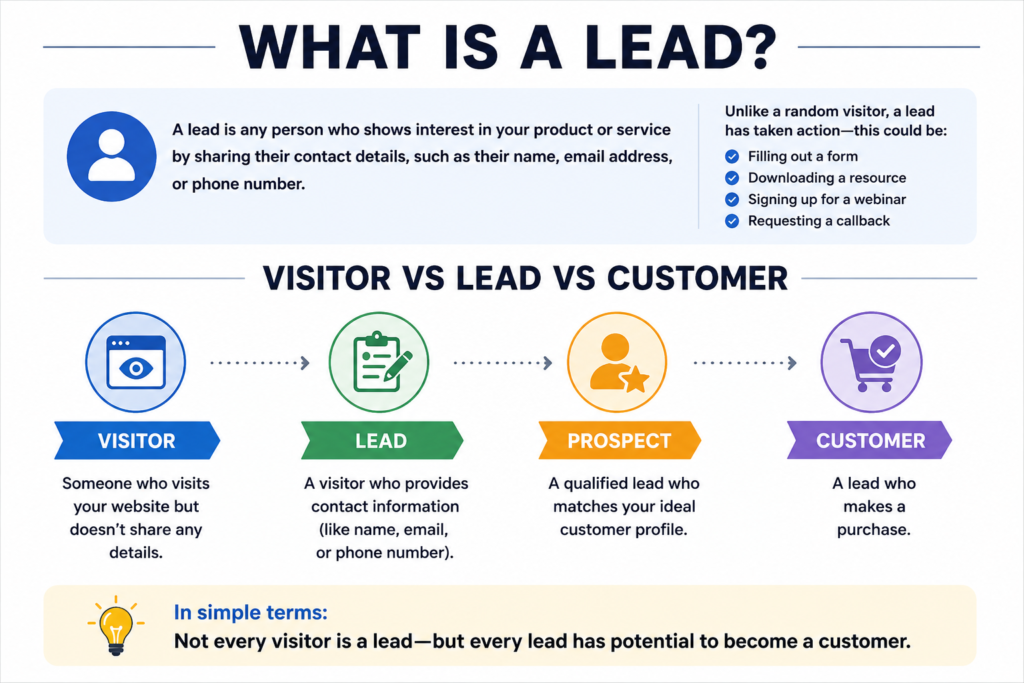
Unlike a random visitor, a lead has taken action—this could be:
- Filling out a form
- Downloading a resource
- Signing up for a webinar
- Requesting a callback
Visitor vs Lead vs Customer
Understanding this difference is crucial:
- Visitor: Someone who visits your website but doesn’t share any details
- Lead: A visitor who provides contact information
- Prospect: A qualified lead who matches your ideal customer profile
- Customer: A lead who makes a purchase
In simple terms:
Not every visitor is a lead—but every lead has potential to become a customer.
Types of Leads in Digital Marketing
Not all leads are equal. They are categorized based on their readiness to buy:

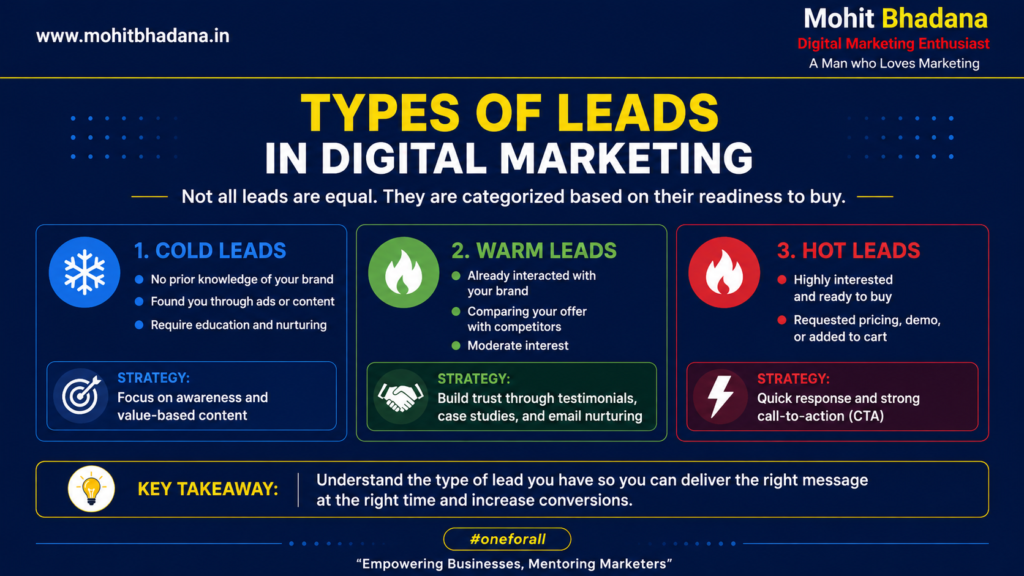
1. Cold Leads
- No prior knowledge of your brand
- Found you through ads or content
- Require education and nurturing
Strategy: Focus on awareness and value-based content
2. Warm Leads
- Already interacted with your brand
- Comparing your offer with competitors
- Moderate interest
Strategy: Build trust through testimonials, case studies, and email nurturing
3. Hot Leads
- Highly interested and ready to buy
- Requested pricing, demo, or added to cart
Strategy: Quick response and strong call-to-action (CTA)
What is Lead Generation?
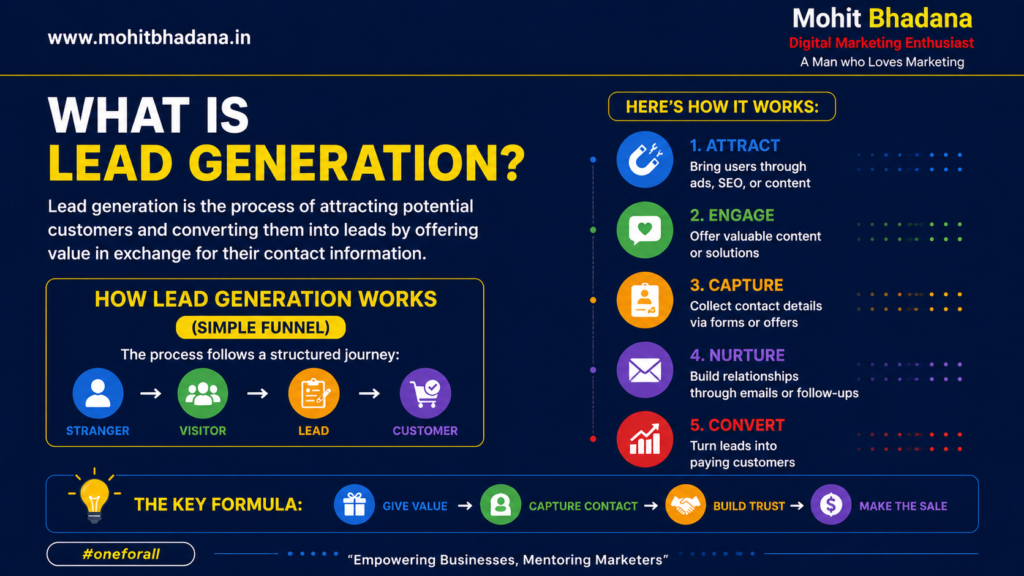
Lead generation is the process of attracting potential customers and converting them into leads by offering value in exchange for their contact information.
How Lead Generation Works (Simple Funnel)
The process follows a structured journey:
Stranger → Visitor → Lead → Customer
Here’s how it works:
- Attract: Bring users through ads, SEO, or content
- Engage: Offer valuable content or solutions
- Capture: Collect contact details via forms or offers
- Nurture: Build relationships through emails or follow-ups
- Convert: Turn leads into paying customers
The key formula:
Give value → Capture contact → Build trust → Make the sale
How to Generate Online Leads (Proven Methods)
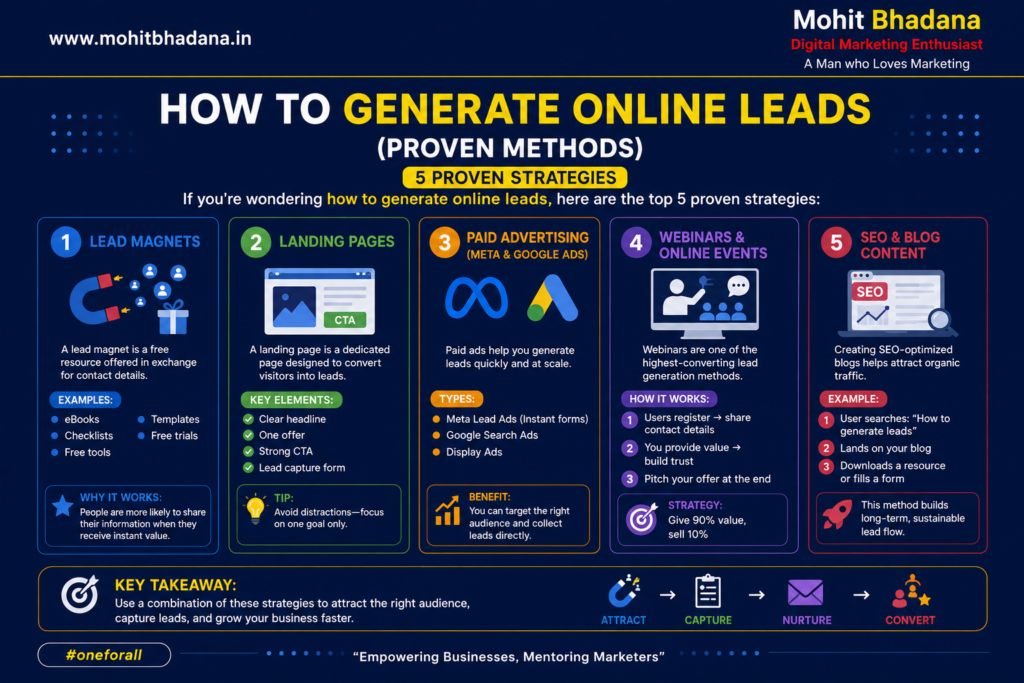
If you’re wondering how to generate online leads, here are the top 5 proven strategies:
1. Lead Magnets
A lead magnet is a free resource offered in exchange for contact details.
Examples:
- eBooks
- Checklists
- Free tools
- Templates
- Free trials
Why it works:
People are more likely to share their information when they receive instant value.
2. Landing Pages
A landing page is a dedicated page designed to convert visitors into leads.
Key elements:
- Clear headline
- One offer
- Strong CTA
- Lead capture form
Tip: Avoid distractions—focus on one goal only.
3. Paid Advertising (Meta & Google Ads)
Paid ads help you generate leads quickly and at scale.
Types:
- Meta Lead Ads (Instant forms)
- Google Search Ads
- Display Ads
Benefit: You can target the right audience and collect leads directly.
4. Webinars & Online Events
Webinars are one of the highest-converting lead generation methods.
How it works:
- Users register → share contact details
- You provide value → build trust
- Pitch your offer at the end
Strategy:
Give 90% value, sell 10%
5. SEO & Blog Content
Creating SEO-optimized blogs helps attract organic traffic.
Example:
- User searches: “How to generate leads”
- Lands on your blog
- Downloads a resource or fills a form
This method builds long-term, sustainable lead flow.
Real-World Lead Generation Examples
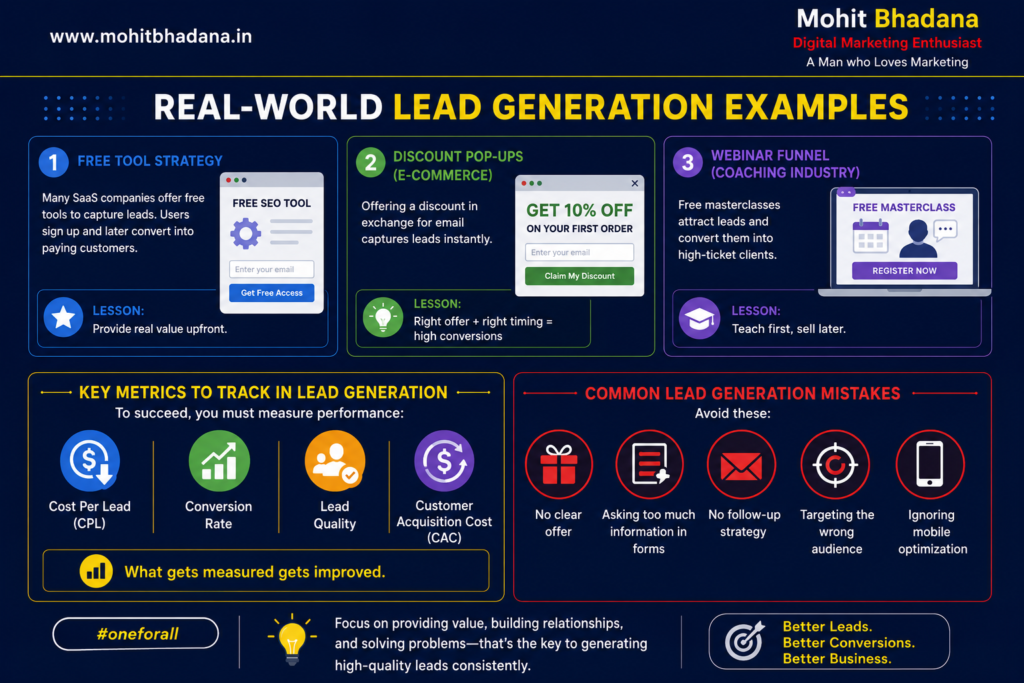
1. Free Tool Strategy
Many SaaS companies, like Hubspot, semrush and Brand 24 offer free tools to capture leads. Users sign up and later convert into paying customers.
Lesson:
Provide real value upfront.
2. Discount Pop-Ups (E-commerce)
Offering a discount in exchange for email captures leads instantly.
Example:
“Get 10% OFF on your first order.”
Lesson:
Right offer + right timing = high conversions
3. Webinar Funnel (Coaching Industry)
Free masterclasses attract leads and convert them into high-ticket clients.
Lesson:
Teach first, sell later.
Key Metrics to Track in Lead Generation
To succeed, you must measure performance:
- Cost Per Lead (CPL)
- Conversion Rate
- Lead Quality
- Customer Acquisition Cost (CAC)
What gets measured gets improved.
Common Lead Generation Mistakes
Avoid these:
- No clear offer
- Asking too much information in forms
- No follow-up strategy
- Targeting the wrong audience
- Ignoring mobile optimization
FAQs
1. What is a lead in digital marketing?
A lead is a person who shows interest in your product or service by sharing their contact details, such as email or phone number.
2. What is lead generation?
Lead generation is the process of attracting potential customers and collecting their contact information to convert them into buyers.
3. How to generate online leads quickly?
You can generate online leads using paid ads, landing pages, lead magnets, webinars, and SEO-based content marketing.
4. What are the types of leads?
The three main types are cold leads, warm leads, and hot leads, based on their readiness to purchase.
5. Why is lead generation important?
Lead generation helps businesses build a pipeline of potential customers, increasing sales and long-term growth.
Lead generation campaigns become more effective when you combine owned, earned, and paid media. Explore our guide on Types of Media in Digital Marketing.


Digital Marketing Strategist , Consultant & Trainer